Application of Industrial Borescope in Pipeline Welding
Pipeline welding is a critical process in the construction, operation, and maintenance of pressure piping, process pipelines, and oil and gas transmission networks. As the core areas where stress concentrates and structural integrity is most vulnerable, the quality of the weld bead directly determines the pipeline's sealing capability, pressure-bearing capacity, and operational safety.While external visual inspections can identify surface-level issues after welding, the inner weld bead often harbors numerous hidden defects. Traditional methods—such as ultrasonic and radiographic testing—suffer from drawbacks like operational complexity, site constraints, a lack of direct imaging, and high costs. As a visual non-destructive testing (NDT) tool, the industrial endoscope can be inserted directly into the pipeline to provide a clear view of the inner weld bead's condition and precisely detect various hidden welding defects. It is suitable for post-weld acceptance, re-inspection after repairs, and periodic in-service inspections of process pipelines made from materials such as carbon steel, stainless steel, and alloys, making it an indispensable aid for quality control in pipeline welding.
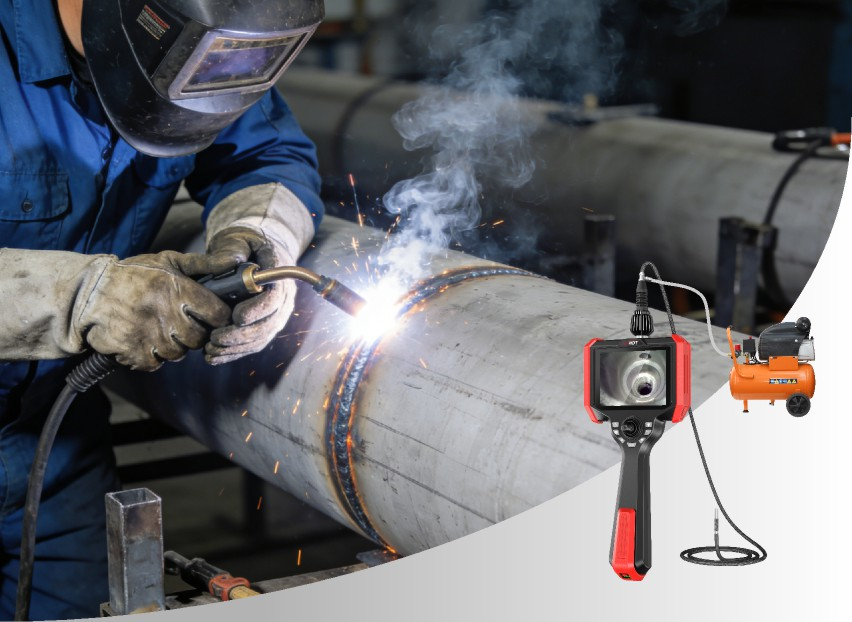
Common Hidden Inner-Wall Defects in Pipeline Welding
During pipeline welding, factors such as welding processes, operator techniques, environmental conditions, and pipe materials can easily lead to various hidden defects on the inner weld bead that are invisible to the naked eye. These defects are the primary targets for endoscopic inspection and include the following types:
Defects related to weld formation: Internal icicles (excessive penetration), concavity, collapse, excessive reinforcement height, uneven weld width, misalignment, and incomplete fill. These defects alter the cross-sectional area of the internal flow path, causing turbulence and intensified erosion, which accelerates weld wear and degradation.
Fusion-related defects: Incomplete root penetration, lack of sidewall fusion, and lack of inter-run fusion. These are critical, high-risk defects that significantly reduce the structural strength of the weld, making it highly susceptible to cracking and failure under pressure or vibration.
Impurity-related defects: Internal porosity, slag inclusions, tungsten inclusions, and residual oxide scale. These defects create stress concentration points that can propagate over time during operation, leading to failures such as leakage or cracking. Crack-type defects—such as cold cracks, hot cracks, delayed cracks, and root micro-cracks (especially hairline cracks)—are easily missed during conventional inspections and pose a major risk for future pipeline leaks or ruptures.
Key Application Scenarios for Industrial Endoscopes in Pipeline Welding
(i) Post-welding acceptance inspection for new pipelines
Upon completion of welding for new or retrofitted pipelines, endoscopes serve as a primary visual inspection tool to conduct comprehensive internal wall checks on all butt welds, socket welds, and bend welds. By inserting an ultra-fine, flexible probe through pipeline ends or designated inspection ports and adjusting the probe angle 360°, inspectors can fully observe the formation of the weld root, bevel, and heat-affected zone. This allows for the rapid identification of defects such as incomplete penetration, weld spatter (icicles), concavity, porosity, and cracks. Unlike traditional non-destructive testing (NDT), endoscopic inspection requires no specialized certification or complex equipment setup and poses no radiation hazards; it enables quick preliminary screening to identify substandard welds before pressure testing, thereby controlling welding quality at the source.
(ii) Re-inspection following weld defect repair
For welds that fail initial inspection, endoscopes allow for precise verification of repair quality after grinding and re-welding. Inspections focus on detecting issues such as secondary lack of fusion, porosity in the repair area, localized collapse, or over-grinding. This ensures that defects are completely eliminated and the internal weld profile is uniform and regular, preventing incomplete repairs or lingering hidden defects. Additionally, the condition of the weld before and after repair can be visually documented, providing a visual record for quality traceability.
(iii) Periodic inspection of in-service pipeline welds
For pressure pipelines and oil/gas transmission pipelines in long-term operation, welds are susceptible to factors such as medium corrosion, pressure fluctuations, mechanical vibration, and thermal cycling. These conditions can lead to secondary defects, including fatigue cracks, weld corrosion, internal wall spalling, and traces of micro-leakage corrosion. Endoscopes enable online inspections—either without halting operations or with only brief shutdowns—to periodically examine the internal condition of in-service welds. This allows for the timely detection of early-stage, minute aging defects and the assessment of potential weld failure risks. Consequently, maintenance and pipe replacement plans can be formulated in advance, preventing safety incidents such as sudden leaks or pipe bursts during the mid-to-late stages of pipeline operation.
(IV) Specialized Inspections for Pipelines in Challenging Conditions
For scenarios inaccessible to conventional flaw detection equipment—such as small-diameter pipes, curved sections, dense pipe arrays, and deeply buried lines—industrial endoscopes offer distinct advantages. Their slender probes, flexibility, and long-range capabilities allow them to easily reach inspection blind spots and assess weld quality in confined spaces and complex piping layouts. This overcomes the limitations of traditional non-destructive testing (NDT) regarding accessibility, ensuring comprehensive, "zero-blind-spot" quality inspections of pipeline welds.
Advantages of Endoscopic Weld Inspection over Traditional Methods
- Full Visualization and Intuitive Defect Identification: High-definition internal imagery is transmitted in real-time, allowing for the direct observation of defect morphology, location, and size. Unlike ultrasonic or radiographic testing, which rely on interpreting complex signal patterns or radiographs, this method is intuitive and easy to understand, enabling rapid assessment of weld quality issues.
- Safe, Harmless, and Low Operational Barrier: There is no risk of radiation exposure, eliminating the need to isolate work areas or disrupt surrounding construction and production activities. No special protective equipment is required, making it suitable for various scenarios—from in-service plant inspections to on-site construction checks—while ensuring a high level of operational safety.
- Efficient Non-Destructive Testing: Inspections require no pipe grinding, disassembly, or damage to anti-corrosion coatings. As a purely visual NDT method, a single operator can quickly inspect multiple weld joints, significantly boosting quality control efficiency and reducing inspection costs.
- Traceable Data and Standardized Archiving: The system supports real-time image capture, video recording, and location annotation. Inspection data for every weld can be fully preserved to create quality records, meeting standardized requirements for project acceptance, quality audits, and maintenance traceability.
- Practical Considerations for Pipeline Weld Inspection Using Endoscopes
- Before inspection, clean the pipe ends and remove internal weld slag, dust, and oil residue. This prevents impurities from obscuring the lens or compromising image clarity, ensuring the weld area is fully visible. 2. Select the appropriate probe based on the pipe diameter and bend angle; use ultra-slim rigid or flexible probes for small-diameter pipes, and universally adjustable probes for bent or irregularly shaped pipes to ensure comprehensive inspection without blind spots.
- During inspection, advance the probe slowly and rotate it at a constant speed, focusing on critical, vulnerable areas such as weld roots, bevel faces, and heat-affected zones to prevent missed defects caused by rapid scanning.
- Visual inspection using endoscopes serves as a preliminary screening and supplementary method for weld quality; however, for high-pressure or high-risk pipelines in special equipment, compliance acceptance must also incorporate Radiographic Testing (RT) or Ultrasonic Testing (UT) to ensure results meet industry standards.

Shenzhen Vsndt Co., Ltd. possesses extensive experience in internal visual inspection and the development of industrial endoscopes, offering customized solutions tailored to client needs. Please feel free to contact us regarding any industrial endoscope requirements.